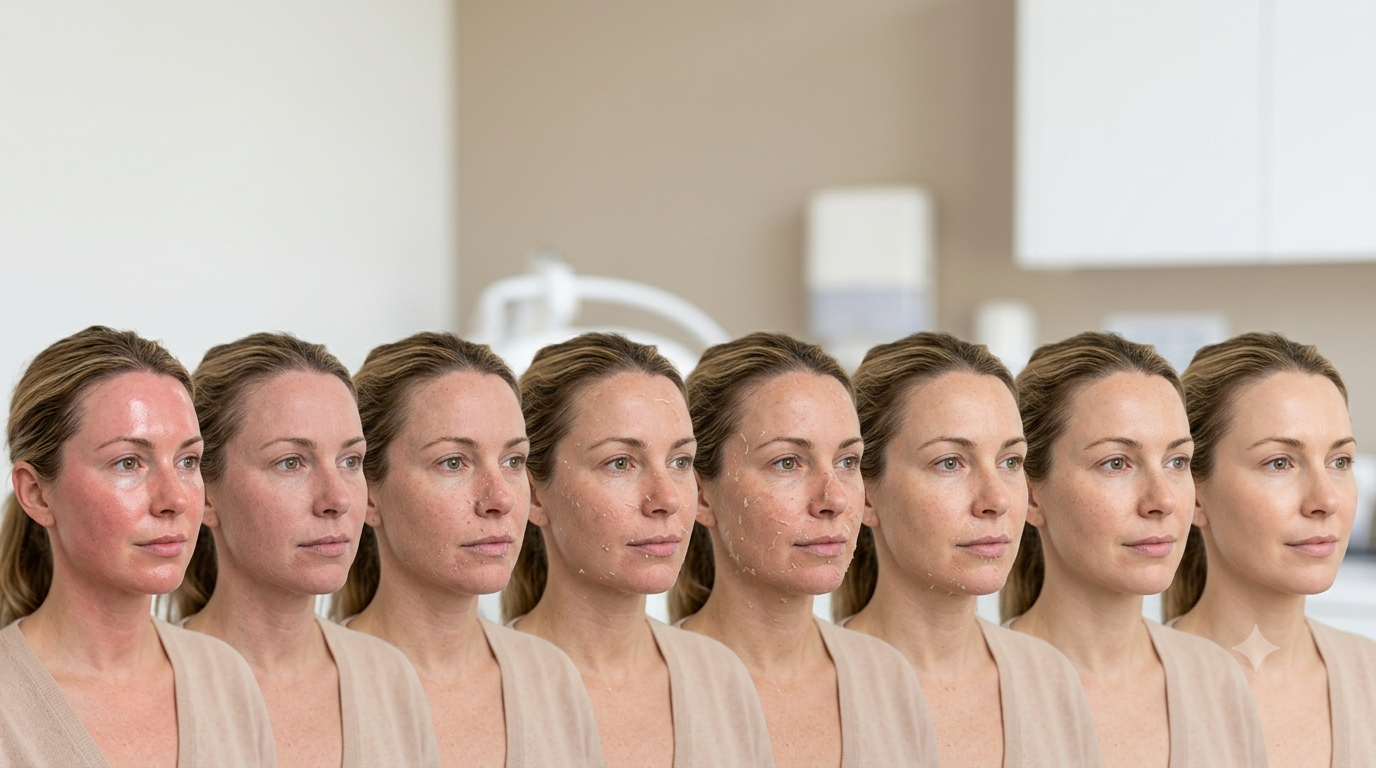
Imagine you have a chemical peel on Monday morning because you want smoother, brighter skin for an event the following week. That evening, your face feels warm and tight, but it doesn’t look dramatically different. On Tuesday, the dryness becomes more noticeable. By Wednesday or Thursday, you may see small flakes around your nose, mouth, and chin, and you might wonder, “Is this normal?”
By Friday, the peeling may be more obvious, while some areas of your face may already look smoother. Over the weekend, the flaking often starts to settle, and by the following Monday, a light peel may look much calmer. But here’s the important part: not everyone’s skin follows the same seven-day schedule.
The type and strength of the chemical peel make a big difference. A light superficial peel may cause mild dryness and little visible peeling, while a stronger or medium-depth peel can require considerably more recovery time.
So, if you’re searching for the chemical peel process day by day, you probably want one simple answer: When will I start peeling? How bad will it look? Can I go to work? When can I wear makeup? When will my skin look normal again?
The good news is that chemical peel recovery is usually easier to understand when you break it into stages. However, there is one important point to know first: not every chemical peel follows the same seven-day timeline.
This guide walks you through each stage, from treatment day through the second week, while explaining what is normal, what you should avoid, and when you should contact your provider
Chemical Peel Process Day by Day at a Glance
For a typical light superficial peel, the first week may look something like this:
| Day | What you may notice | What to focus on |
|---|---|---|
| Day 0 | Warmth, tingling, redness, tightness | Follow post-treatment instructions |
| Day 1 | Dryness, tightness, mild redness | Gentle cleansing and moisturizing |
| Day 2 | Dryness and possible early flaking | Don’t pick or scrub |
| Day 3 | Peeling may become more noticeable | Protect and moisturize the skin |
| Day 4 | Peeling may be at its most visible | Let skin shed naturally |
| Day 5 | Peeling may begin slowing | Continue gentle aftercare |
| Day 6 | Less visible flaking | Keep protecting the recovering skin |
| Day 7 | Many light peels look much calmer | Resume products only as advised |
| Week 2+ | Gradual improvement continues | Maintain sun protection and routine |
This timeline is most useful for light to moderate superficial treatments. Medium-depth peels can take longer, and some peels cause little visible peeling at all.
What Determines How Much You Will Peel?
The biggest mistake is assuming that every chemical peel causes dramatic sheets of skin to come off.
It doesn’t.
The amount of visible peeling depends on the type and depth of the peel, not simply on whether the treatment was successful. A superficial peel may produce mild scaling that looks like dry skin. Another treatment may cause much more obvious shedding.

Common peeling agents include glycolic acid, salicylic acid, lactic acid, and TCA-based formulations. They don’t all behave the same way, and professional peel protocols can vary considerably.
Your provider may also adjust the treatment according to your skin condition and goals. Someone being treated for oily, acne-prone skin may receive a different approach from someone targeting pigmentation or sun damage.
Your previous skincare routine can matter too. If your skin has recently been irritated by retinoids, exfoliating acids, waxing, or excessive sun exposure, your provider may change the treatment plan or recommend delaying treatment.
The safest way to predict your recovery is to ask which peel you are receiving, how deep it is, and what downtime your provider expects.
Chemical peels are one of many professional skincare treatments. Learning about skincare techniques and esthetics training provides a broader look at professional skin-care practices.
Day 0: Chemical Peel Treatment Day
Day 0 is when the peel is actually performed.
The provider cleans and prepares your skin before applying the chemical solution. Depending on the product, you may feel tingling, warmth, stinging, or burning while it is on your skin.
The sensation can be uncomfortable, but it should be managed according to the treatment protocol. The provider may neutralize or remove the solution, or follow the specific instructions for a peel designed to remain on the skin.
Immediately afterward, your face may look pink or red. It can feel tight and warm, similar to a mild sunburn.
Don’t expect to see the final result yet.
At this point, your skin is beginning its response to the treatment. The visible peeling usually happens later, not immediately after the solution is applied.
Can You Go to Work After a Chemical Peel?
That depends on the peel.
After some superficial peels, people can return to normal daily activities fairly quickly. You may still have redness or tightness, however, so whether you feel comfortable going to work depends on your job and how your skin looks.
If your work involves heavy sweating, heat, dust, outdoor exposure, or direct sunlight, ask your provider whether you should modify your activities.
For a stronger peel, plan for more downtime.
Day 1: Tight, Dry, and Sensitive Skin
Day one is often less dramatic than people expect.
Your skin may feel tight, dry, warm, or mildly sensitive. Redness can still be visible. Some people don’t see any peeling yet.
This doesn’t mean the treatment isn’t working.
A common mistake is to look in the mirror on day one and think, “Nothing happened.” Chemical peels are not designed to provide their entire result within a few hours. The skin changes over time as the treated cells shed and the skin recovers.
Keep your routine simple.
Use the cleanser, moisturizer, and other products recommended by your provider. Avoid experimenting with new skincare products during this period.
Sun protection is especially important because recently treated skin can be more sensitive to ultraviolet exposure.
Day 2: Dryness and Early Flaking
Day two is when some people begin seeing the first signs of peeling.
You may notice small flakes around the mouth, nose, chin, or cheeks. Other people may simply notice that their skin feels unusually dry.
Both experiences can be normal.
The peeling may not happen evenly. One cheek might start flaking before the other. The skin around the mouth may peel while the forehead looks relatively normal.
Don’t try to make the peeling happen faster.
Using a scrub, exfoliating acid, cleansing brush, or fingernails to remove loose skin can cause additional irritation. The goal isn’t to get every flake off as quickly as possible. The goal is to allow your skin to recover without unnecessary trauma.
Day 3: Peeling Becomes More Noticeable
For some superficial peels, day three is when visible peeling becomes obvious.
You may see fine flakes or larger areas of scaling. Your skin may also feel rough temporarily.
This can be the stage that causes the most concern because your face may look worse before it looks better.
That’s why timing matters.
If you have an important wedding, photo shoot, vacation, presentation, or other event coming up, don’t schedule a peel immediately beforehand unless your provider specifically recommends that timing.
And remember: visible peeling is not a scorecard for the treatment.
Someone who barely peels can still receive an effective superficial peel. Someone who peels heavily hasn’t necessarily received a better treatment.
Day 4: The Peeling May Be at Its Most Visible
For some light-to-medium treatments, day four can be one of the most noticeable peeling days.
Loose skin may appear around the mouth and nose, while the cheeks or forehead may follow at a different pace.
You may feel tempted to pull off the flakes, especially if they catch on clothing or makeup.
Don’t.
Picking or pulling can increase irritation and may contribute to discoloration or delayed healing. This is particularly important if you are prone to post-inflammatory hyperpigmentation.
Continue with the aftercare routine recommended for your particular peel.
If your provider has told you to use a specific moisturizer or healing product, follow those instructions rather than replacing it with a strong active skincare product.
Day 5: Peeling Starts to Settle
By day five, a light peel may begin to look much calmer.
Some areas may have stopped peeling completely, while small dry patches remain. You may begin noticing a smoother or brighter appearance in areas where the peeling has finished.
But don’t assume your skin is completely recovered just because the flakes are disappearing.
The skin barrier may still be sensitive.
Continue avoiding unnecessary irritation and protect your face from the sun. If your provider gave you a specific timeline for restarting retinoids, exfoliating acids, acne treatments, or other active products, follow that timeline.
Day 6: Less Peeling, More Even Texture
By day six, many people with a light peel have considerably less visible peeling.
Your skin may look smoother and more even. Mild dryness or pinkness can still be present.
This is also the point where some people make another mistake: they immediately restart their entire skincare routine.
Don’t rush.
The fact that your face looks better doesn’t automatically mean the skin barrier has completely returned to normal. Ask your provider when it is appropriate to restart stronger products.
Continue using sun protection and avoid picking at any remaining flakes.
Day 7: What Should Your Skin Look Like?
After a light superficial peel, much of the visible peeling may have settled by day seven.
Your skin may look brighter, smoother, and more even. However, you may still have mild dryness, sensitivity, or pinkness.

And here’s an important correction to the common “seven-day” promise: not everyone will be finished healing on day seven.
If you received a medium-depth peel, your recovery can take substantially longer. Even after visible peeling stops, the skin can continue changing and recovering.
Don’t compare your face to a seven-day social-media transformation. Your treatment may have a different protocol and a different recovery pattern.
What If You Don’t Peel at All?
This is one of the most common questions after a chemical peel.
Not seeing obvious peeling does not automatically mean your peel failed.
Some superficial treatments cause very little visible flaking. You may notice dryness, tightness, or a subtle change in texture instead.
The effectiveness of a peel should not be judged by how much skin you can see coming off.
If you were expecting dramatic peeling and have seen almost none, ask your provider what type of peel you received and what result they expected. They can tell you whether your recovery matches the treatment that was performed.
Can You Go to Work During Chemical Peel Recovery?
For a light peel, you can continue working, especially if your job is indoors and doesn’t require significant heat or sun exposure.
The bigger issue may be appearance rather than physical ability.
During the peeling stage, your skin can look dry, flaky, or uneven. If your job involves frequent public interaction, you may prefer to schedule the treatment when you have fewer important meetings.
If you’re an Outdoor worker, you may need additional precautions because sun exposure can be particularly undesirable while your skin is recovering.
For a medium-depth peel, expect more downtime and follow your provider’s specific instructions.
Can You Wear Makeup After a Chemical Peel?
The answer depends on the type of peel and the condition of your skin.
Some superficial peel protocols allow makeup relatively soon, while others recommend waiting. If your skin is actively peeling, irritated, raw, or uncomfortable, covering it with makeup may not be appropriate.
Don’t use makeup as a way to hide peeling if your provider has told you to avoid it.
Once your skin has recovered sufficiently and your provider says makeup is acceptable, use clean products and avoid aggressive removal.
If you have an important event, ask about makeup timing before getting the peel rather than making a last-minute decision during recovery.
What Should You Put on Your Skin After a Chemical Peel?
Post-peel skincare should usually be simple.
Your provider may recommend a gentle cleanser, moisturizer, healing product, and sunscreen. Follow those instructions because the correct routine depends on the peel you received.
Avoid automatically reaching for:
- Facial scrubs
- Strong exfoliating acids
- Retinoids
- Aggressive acne treatments
- Waxing
- Exfoliating brushes
- Products that sting or burn
The goal during recovery is not to create more exfoliation.
The chemical peel has already provided the exfoliating treatment.
Your job now is to protect the recovering skin.
What Not to Do During the Peeling Stage?
The most important rule is simple: don’t pick the peeling skin.
It may look harmless when a piece of skin is already loose, but pulling it away can cause unnecessary trauma.
You should also avoid tanning and unnecessary direct sun exposure. Use sun protection according to your provider’s recommendations and take additional physical precautions when appropriate.
Don’t add multiple active ingredients because you think they will improve the result faster.
And don’t schedule another aggressive facial treatment simply because your skin looks dry.
Give the skin time to recover.
When Is Chemical Peel Peeling Not Normal?
Some redness, dryness, tightness, and peeling can be expected.
Certain symptoms, however, deserve professional attention.
Contact your healthcare provider if you develop severe or worsening pain, significant swelling, blistering, signs of infection, unusual drainage, or redness that is becoming increasingly severe.
Don’t assume that every uncomfortable symptom is simply part of the peeling process.
If you have concerns about how your skin looks or feels, the professional who performed your peel can assess your skin based on the exact product and strength used.
Chemical Peel Recovery
The phrase “chemical peel” covers treatments with very different levels of intensity.
A light superficial peel generally affects the outermost layers of skin and tends to have shorter downtime. Dryness and mild flaking may be the main visible effects.
A medium-depth peel reaches deeper and usually causes more noticeable inflammation and peeling. Recovery can extend beyond the one-week timeline commonly discussed online.
A deep chemical peel is a different category altogether and involves substantially more downtime and medical considerations.
This distinction is important because telling every reader that their skin will be completely recovered in seven days can create unrealistic expectations.
Before treatment, ask three questions:
- What type of peel am I receiving?
- How much visible peeling should I expect?
- How many days of downtime should I plan for?
Those answers are much more useful than simply knowing the name “chemical peel.”
When Can You See the Final Chemical Peel Results?
Visible peeling and final results are two different things.
Your skin may look smoother once the peeling settles, but improvements in pigmentation, texture, acne, and other concerns can continue developing after the first week.
The timing depends on the problem being treated and the type of peel used.
Don’t expect every concern to disappear after one treatment.
Some people may benefit from a planned series of superficial treatments, while others may need a different approach. The number and timing of treatments should be based on your skin, treatment goals, and professional assessment rather than a fixed schedule.
How Long Should You Wait Before Another Chemical Peel?
There isn’t one correct interval for everyone.
The appropriate gap depends on the peel depth, formulation, your skin’s recovery, and the problem being treated.
Having another peel too soon can unnecessarily irritate the skin. Your provider should determine when your skin is ready for another treatment.
A series can be useful for some concerns, but “more peels” is not automatically better.
How to Plan a Chemical Peel Before an Important Event?
If you’re considering a peel before a wedding, vacation, work event, or photo session, don’t plan around the most optimistic recovery timeline.
A safer approach is to give yourself more recovery time than the minimum expected downtime, especially if you have never had that particular peel before.
For an important event, ask your provider:
- How many days will I probably peel?
- When can I wear makeup?
- When can I exercise?
- When can I return to my normal skincare?
- What should I do if I’m still peeling on the expected final day?
This gives you a backup plan instead of hoping your skin follows an exact schedule.
Bottom Line
The chemical peel process day by day usually starts with warmth, redness, or tightness on treatment day. During the next few days, dryness and possible peeling become more noticeable. With many light peels, visible peeling begins around days two to three, may be most obvious around days three to four, and gradually decreases over the following days.
But there is no universal seven-day recovery clock.
A light superficial peel can be relatively easy to manage, while a medium-depth peel may require substantially more downtime. Some people peel heavily, while others barely flake. Neither amount of peeling should be used alone to judge whether the treatment worked.
The safest approach is to follow your provider’s aftercare instructions, avoid picking or scrubbing the skin, protect yourself from the sun, and give your skin time to recover.
If you understand the timeline before treatment, the peeling stage becomes much less surprising—and much easier to plan around.